
• About
  • Recipe Index
  • Daddy Oh

an everyday life

an everyday life

Category Archives: Life at Home

Happy Holiday Tour 2009

22 Sunday Nov 2009

Posted by Janell in Life at Home, Mesta Park, Soul Care

≈ Leave a comment

Tags

Everyday Life, Historic Living, Mesta Park, Mesta Park Holiday Home Tour, OKC, Soul Care

When tour home doors  open the first weekend of December, it will be our great hope to  live up to  Perle Mesta’s reputation as  the “Hostest with the Mostest.”

This year’s five homes  — the stars of Mesta Park’s 32nd Holiday Home Tour — congregate in the west-end of the historic district — just a few hops, skips and a jump from one another …especially the two who are ‘shouting neighbors.’

For the physically able, the weekend will offer a great opportunity to see  the USA neighborhood in their Chevrolegs.  Or if that sales pitch isn’t convincing,  how about this one:? — Just like Nancy Sinatra’s go-go boots, this old neighborhood was made for walking so seeing it by foot is the absolute best way.  That is, as long as the weather plays nice.

There’s no better place to see examples of Oklahoma City’s oldest historic housing.  While it’s true Mesta Park homes share a similar vintage to Heritage Hills, Mesta Park’s unique appeal is that its homes are — well how do I put this?   —  well, they’re just a bit more historical.

Our district is still being “gentrified”;  many homes are still in need of a caring owner who will bring it back to its former splendor.  This year’s tour features two tour homes that have undergone that painstaking transformation.    I’ve discovered some  homes off -tour still have their original kitchen layout and cabinetry, though of course the appliances have changed with the times.  So my point is this:  since Mesta Park homes have undergone less updates over the years, much more of what “tourists” are likely to see is what  the home’s first tenants actually saw and used.

Take my own home for instance, which appeared on the tour three years ago.   All our upstairs bath fixtures are original with few exceptions.  If you pull up the lid of the back of our potty’s water tank, it’s date stamped “1928.”  Our house has some original light fixtures, original door hardware and the original wavy window glass in most of our panes.    Most  tour home kitchens (like mine) are modern.  But the rest of the best will be historical, from the bottom of the original wood floors to the top of the ornate wood and crown moldings.  I speculate that, at least in the spirit of interior historical preservation, it pays to be the poor cousin of the neighborhood.

Most Mesta Park homes are modest in comparison to Heritage Hills.  But Mesta Park has its shares of mansions, with Perle Mesta’s home, sitting at the corner of Northwest 16th and Lee being its most famous.  Most of Mesta Park’s mansions sit within easy walking distance to the “boulevard” — that little stretch of road where the streetcar once traveled up Shartel Avenue before it rounded the corner to head west on 18th Street.  Three of this year’s tour homes rest on the old boulevard streetcar route — with the other two just steps away.

Here’s a sneak preview of this year’s tour homes.  Exterior shots only.  But doesn’t it make you want to peek inside?

We who live in and love our historic homes recognize our place as our home’s temporary caretakers.  I look forward to meeting each to see how the years have treated them, and as I walk through the rooms, I will wonder about the families that once called it home..

Whether we own or rent, it doesn’t really matter; living in a historic home reminds us that we are all travelers — tourists really — just passing through; and that these old homes on this patch of earth will outlive us all.

And by candlelight on the first Saturday evening in December, they will outshine us all too.

801 Northwest 17th Street - Built 1910

905 Northwest 16th Street -- Built 1914
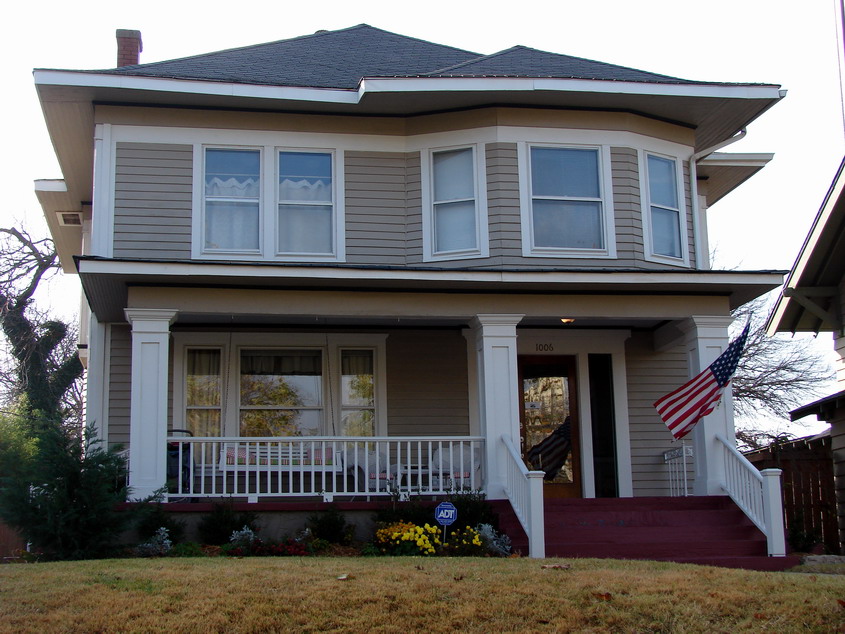
1006 Northwest 18th Street - Built 1918

1009 Northwest 18th Street - Built 1910

924 Northwest 20th Street - Built 1914

Citrus Blues

21 Saturday Nov 2009

Posted by Janell in In the Garden, Life at Home

≈ 9 Comments

Tags

Aphids, Citrus Trees, Everyday Life, Master Gardeners, Oklahoma Gardening

We are late for our first seasonal freeze.

Even so, two freeze warnings have sent us scurrying at night to protect our sensitive citrus.  The garage has held the Key Limes for close to thirty nights while our small kitchen has twice hosted our hardier citrus.  Soon the run-from-the-freeze games will end and our citrus will have no choice but to take up their winter quarters on our sun porch.

All the moving of heavy plants has led me to mover’s regret; I should not have moved those lovely southern belles out of their natural hot house environment.  There in Lake Jackson, my citrus could have been planted in the ground to grow tall and produce many fruit.  Here, the best they can become are small unmanageable container plants.

I didn’t know citrus could grow so fast.  Four years ago, they wore one gallon pots.  And now that their feet have outgrown seven gallon pots, I’m trying to recall why I thought growing citrus in Oklahoma was a good idea.

The more I garden, the more I come to believe that it’s best to cultivate what naturally grows in the place one is planted.  Every part of the world must offer its own beauty.  Here in central Oklahoma, I grow peonies and hollyhocks and spring bulbs like Daffodils that I had no prayer of growing in South Texas.  Citrus do not belong in Oklahoma.

But here I sit, mother to four citrus trees —  two tender very productive Key Limes that shiver and turn blue if the thermostat drops below 48F; and two hardier citrus that have yet to earn their keep — a fruitless but very pretty Meyer Lemon and a Satsuma Orange that delivered its first ever bumper crop this season.  Two oranges.

The worst of my citrus blues are the aphids; —  ugly, tiny, pear-shaped insects found on the bottom of leaves — after fighting these little buggers all year, I gave up in September.  But now the trees look so sad I can no longer ignore them, especially those two making eye contact in our shared kitchen quarters.

With wet soapy sponge in hand, I began first-aid on the orange tree three days ago.  Leaf by leaf, the black sooty mold and sticky honey-dew is slowly disappearing.  Three hours into my ministry, I have 75 percent of one tree completed; in just ten more hours , I will land on the spot marked “Routine Citrus Care.”

Today I sprayed all the clean leaves with Safer Insecticidal Spray to temporarily insulate them from further attack. Given that the soap needs to be sprayed every week, I’m planning on making my own home-made formula for the sake of convenience and cost.  Then, for the rest of our unnatural shared lives together, I will give these little four-foot darlings a drenching soapy shower every week, even if they tell me they don’t really need it.

So what else is a mother of four citrus in Oklahoma to do?

I tell myself that the care of these citrus trees will be no different from the rest of everyday life.  After all, the human experience is an around-and-around-we-go sort of existence;  whether it’s personal care or our housekeeping or our gardening or our whatever, the work is never done until we’re done for.

There is no other way than to sing the citrus blues.

Unless. The answer is still lurking under that black sooty mold.  Even now the wheels in my head are turning a different way.  Perhaps I could give my cleaned up trees away — even shedding one would yield a 25 percent time savings (to me.)   And after all, who needs two Key Lime trees?

Wouldn’t a cleaned up but very fertile Key Lime tree make some lucky someone a mighty fine Christmas gift?

Granny’s Egg Noodles

20 Friday Nov 2009

Posted by Janell in In the Kitchen, Life at Home

≈ 2 Comments

Tags

Everyday Life, Home-made Egg Noodles, In the Kitchen, Thanksgiving Dinner

During my growing up years, Thanksgiving dinner always meant a huge feast at Granny’s house.  Everyone brought a dish or two and this worked out well, since everyone had their own specialities.  Granny’s were her home-made egg noodles and cornbread dressing.

I haven’t had a stable Thanksgiving table for years.  Once I married, I became a Thanksgiving vagabond, spending many Thanksgivings with in-laws, a few at either Granny’s or my mother’s, but especially in my Texas years, I enjoyed a quiet smallish dinner with my husband and children.  Since returning to Oklahoma, I’ve celebrated Thanksgiving in three places in three years.

This year I’m staying home.  I’ve invited family from hither and yon, a mix of his, mine and ours.  My son Kyle is hoping to bring one of his college friends, an international student from Portugal, who has never experienced an American style Thanksgiving dinner.  And of course, the item that received the most press from my son to his friend was our family legacy of egg noodles.  My table may have changed with the year, but Granny’s noodles and dressing have been a faithful Thanksgiving staple of my moveable feast.

Noodle making is more art than science.  The ingredients are few, the measurements approximate, the process requires time.  I learned to make Granny’s noodles on a sunny autumn weekday when I was twenty-something.  My girls were young — Kate, four and Kara not yet crawling.  Even now, I see us all gathered in Granny’s kitchen.

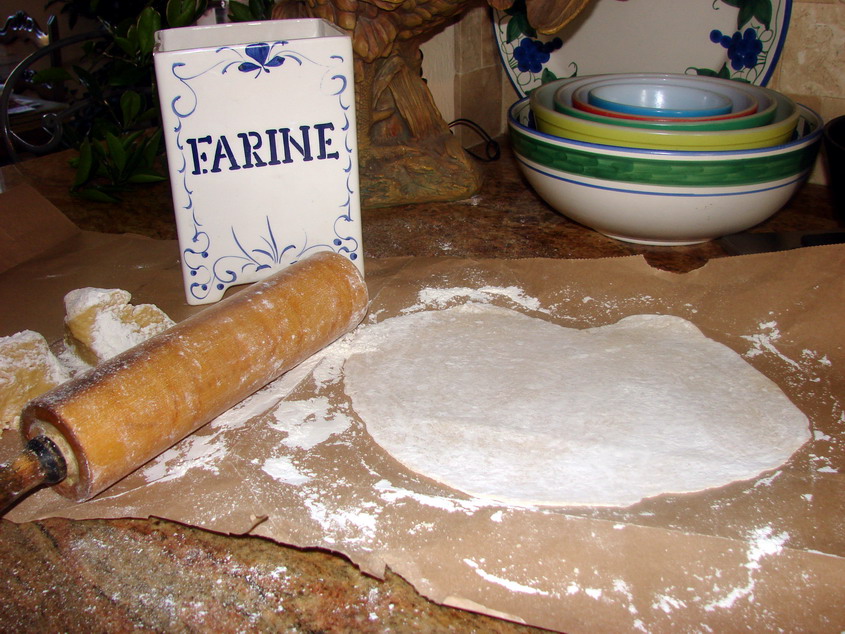
It is time to roll out the noodle dough, which Granny always does on top of her kitchen table that she covers with torn-up paper grocery sacks dusted with flour.  As I divide the dough for rolling, I can hear Granny say, “Jan, be sure and roll that dough real thin.”  Then, later, after the dough has dried, when I cut a few noodles too wide, “Jan, be sure and cut your noodles thin.”  A narrow thin noodle was best in Granny’s book, as thin translates to a tender noodle.

As soon as the noodles were dry to the touch, Granny would package them in a leftover bread bag for the freezer.  Granny always made her noodles in advance, at least a couple of weeks before.  And when she was ready to cook them, the noodles went straight from the freezer into the hot boiling chicken broth.

More than twenty-five years later, I have become Kara’s teacher.  Sometime this weekend, we will be getting together for Kara’s second lesson.  And though I don’t know the day or the hour, I do know how the story will go.  We will do everything just like Granny did, following her unwritten recipe that is better passed on by hand than in longhand… or in keystrokes on a screen.

Kara and I will gather our ingredients.  We will mix, knead and roll the dough.  And then the noodles will be cut, sandwiched between two drying periods.  And when Kara begins to roll the dough, I’ll be sure to say:  “Now roll the dough as thin as you can get it, Kara.”  And later, after the dough has dried sufficiently:  “Now, cut your noodles nice and thin.”

In my life, this is how we make noodles.   — one generation teaching the art to another — repeating the same process and hints until your hands know what words are unable to describe.  Practice makes perfect.

From Granny’s life to mine… and now to Kara’s and your’s.

Granny’s Egg Noodles

Serves 6 to 8

Cooking Time: 20 to 30 mins   Preparation Time:  4 hours (including 3 hours of drying time)

For Dough:
3  large eggs
3 Tbsp half-and-half (can substitute water)
2  to 2 1/4 cups all purpose flour (for dough)
2 cups all purpose flour (for rolling) — sometimes more
1 tsp salt
To Cook:
5 to 6 cups of chicken broth (preferably home-made)
salt to taste

To mix: Mix salt and flour in a bowl.  In a larger bowl, whisk eggs with cream until fully mixed.  Whisk in one cup of flour mixture, removing all lumps.  Then, with a wooden spoon, mix the second cup of flour until fully incorporated.   On clean flat surface,  pour out remaining 1/4 cup of flour and place noodle dough (will be sticky to the touch) on top of the flour —  knead in flour until dough is smooth and slightly tacky.  Any leftover flour can be used for rolling or discarded.  Let dough rest for 10 minutes.

To roll:  Divide dough into 3 even pieces.  Sprinkle remaining flour over rolling surface –torn up paper sacks really helps speed up the drying process.  Roll dough with a rolling pin, continuing to coat dough with flour, until it’s as thin as you can roll it — 1/8 to 1/16 inch.  Continue until all dough is rolled.  Let dry for about an hour, turning once or twice to ensure even drying.

To cut: Roll dough into a tight rolls (like a rolled newspaper) and cut the roll with a sharp knife on a cutting board. Unroll cut noodles.  Allow two or more hours of drying time — humid days extends drying time.  Alternatively, you may cut the dough into narrow strips without rolling.  When I use this method, my noodles are typically shorter in length.  After noodles are dry to touch, place in a freezer bag and into the freezer.

To cook:  In a large pot over medium high heat, bring  5 to 6 cups of chicken broth to a boil.  Taste to adjust salt seasoning once broth is warm.  When boiling, drop in frozen noodles, reduce heat to medium to medium low, and cook covered for 10 to 15 minutes.  Stir occasionally to avoid sticking.  Noodles and broth should be creamy rather than soupy — and water can be added where too thick.

To serve: Over cornbread dressing or mashed potatoes or as a straight-up side.

← Older posts
Newer posts →

“Do any human beings ever realize life while they live it? — every, every minute?”

-- Thornton Wilder, "Our Town"

Enter your email address to receive notifications of new posts.


prev|rnd|list|next
© Janell A West and An Everyday Life, January 2009 to Current Date. Unauthorized use and/or duplication of this material without express and written permission from this blog’s author and/or owner is strictly prohibited. Excerpts and links may be used, provided that full and clear credit is given.

Recent Posts

  • Queen of Salads
  • Sweater Weather
  • Summer Lull Salads
  • That Roman Feast
  • Remodel Redux
  • Déjà vu, Déjà Voodoo
  • One Good Egg

Artful Living

  • Fred Gonsowski Garden Home
  • Kylie M Interiors
  • Laurel Bern Interiors
  • Lee Abbamonte
  • Mid-Century Modern Remodel
  • Ripple Effects
  • The Creativity Exchange
  • The Task at Hand
  • Tongue in Cheek
  • Zen & the Art of Tightrope Walking

Family ~ Now & Then

  • Chronicling America
  • Family
  • Kyle West
  • Pieces of Reese's Life
  • Vermont Digital Newspaper Project

Food for Life!

  • Elizabeth Minchilli in Rome
  • Manger
  • Once Upon a Chef
  • The Everyday French Chef

Literary Spaces

  • A Striped Armchair
  • Dolce Bellezza
  • Lit Salad
  • Living with Literature
  • Marks in the Margin
  • So Many Books
  • The Millions

the Garden, the Garden

  • An Obsessive Neurotic Gardener
  • Potager
  • Red Dirt Ramblings

Archives

Categories

  • Far Away Places
  • Good Reads
  • Home Restoration
  • In the Garden
  • In the Kitchen
  • Life at Home
  • Mesta Park
  • Prayer
  • Soul Care
  • The Great Outdoors
  • Writing

Meta

  • Create account
  • Log in
  • Entries feed
  • Comments feed
  • WordPress.com

Blog at WordPress.com.

Privacy & Cookies: This site uses cookies. By continuing to use this website, you agree to their use.
To find out more, including how to control cookies, see here: Cookie Policy
  • Subscribe Subscribed
    • an everyday life
    • Join 89 other subscribers
    • Already have a WordPress.com account? Log in now.
    • an everyday life
    • Subscribe Subscribed
    • Sign up
    • Log in
    • Report this content
    • View site in Reader
    • Manage subscriptions
    • Collapse this bar
 

Loading Comments...