Hear Ye, Here Ye

Tags

, , , ,

For days I’ve thought about what I would say if not for lassitude.  And now that I’m actually saying something — now that I’m here — would you be surprised to hear how none of it matters?

Yet who can say what matters in the here after — or for that matter, in the here now — and who knows whether what I write today is really my true self talking or whether it slips off the tongue of lassitude?

Yes, with lassitude lurking about, it’s better I draw a few lines around facts — even limiting myself to answering the unasked question of where “here” is.  Describing my here and now is enough  — and unless I’m careful, too much to hear, should I slip and fall between the facts and talk of feelings and memories and all those things fuzzy soft, that change with perspective, with one’s value’s, or on one’s being there.   Or here.

So, keeping to hard facts, here at this very moment of time, I lie in my soft comfy bed with a laptop propped against my legs.  I’ve nothing I must do today.  No where I must go or be.  The  day is mine to spend as I wish.  On this second day of the season of Christmas, while the waiting within the season of Advent is over, I instead wait within the in-between days of my mother-in-law’s death and funeral.

To avoid falling into feelings, I skip to the next fact:  My sister-in-law, who stayed here ten days — and my brother-in-law who stayed two — are now gone to stay elsewhere.  Living with in-laws very different from me — who smoke cigarettes and/or depend upon drinks of alcohol to live — left me in a very un-Christmassy spirit, which is another way of saying, a very non-Christian frame of mind and heart.  Why, living with in-laws lifted my lassitude — if only for a bit  — to take charge of life.  These, I know, as facts.

The in-laws departed Christmas Eve, the very day I ran away from home myself, seeking refuge with my sister, who thank God, is always good at taking in strays who show up on her doorstep, no questions asked.  There we visited and watched movies and make fried bologna sandwiches and watched more movies and ate popcorn in a room heated by a big lovely fire in the hearth that we shared with three other strays Sis had taken in over the years — a chihuahua named Taco, a schnauzer named Eve and a large ragdoll cat named Sophia.  Until my arrival, Sophie was the newbie.

I’ve never run away from home before, though I ended last year wanting to and, if I’m being honest, have thought about it many, many times since.  But never have I given in to the urge to do so.  But two days ago, on the morning of Christmas Eve, I knew if I stayed, I’d end up having ‘words’ with my in-laws — and that those words would become words of regret not long after their speaking — and sometimes — maybe always, though I can’t say for sure since this is not fact — I think it’s better to flee rather than fight.

My plan was to come home right after the funeral, after the in-laws had departed for their next visitation.  But something happened Christmas Eve which caused plans to change:  My husband called to tell me they’d departed early — that the house was quiet in a good way — that my house and life were ready for me when I was ready to come home.

I returned the next day.  And then, as if none of that running away or any of the departures that had come before had happened, we dressed up in our casual-but-festive finery and drove down to the home of my son and new daughter-in-law.  And there, we dined on food that was a pleasure to eyes and palate.  And some drank wine, while others had water or iced tea.  And long after we’d consumed creme brulee, we stayed gathered around the table, doing our best to be merry and make light conversation with members of Amy’s family.  And in spite of all the year has wrought and wrung out of me — in spite of that lingering lassitude within me — it wasn’t hard at all to eat, drink and be merry.

And isn’t this just what another long ago writer expressed, when suffering from his own bout of lassitude?

“Then I commended mirth, because a man hath no better thing under the sun, than to eat, and to drink, and to be merry: for that shall abide with him of his labour the days of his life, which God giveth him under the sun”  — Ecclesiastes 8:15 KJV

By the light of the moon

Tags

, , , , ,

Is truth told by the light of the moon?

Does it unfold as our dreams play out before our inner eye each night, while we lie powerless to change its outcome?  Or as art emulates life, can it get buried in bits of dialogue spoken on the screen, by one featuring the light of full moons and acting by Cher, Nicholas Cage and Olympia Dukakis?

As I breathe in the shrinking December daylight, I cannot shake off certain scenes from Moonstruck, that dark comedy released in the late eighties, that I viewed for the second time while lying in bed last month.  It haunts me.  And I think that maybe I need to watch it again.  Then I think — no — what’s the need?  Already, the lines of the screenplay, weighted by their heavy subject matter — that fish for truth about our living and our dying –  live within me.

Rose: Why do men chase women?
Johnny: Well, there’s a Bible story… God… God took a rib from Adam and made Eve. Now maybe men chase women to get the rib back. When God took the rib, he left a big hole there, where there used to be something. And the women have that. Now maybe, just maybe, a man isn’t complete as a man without a woman.
Rose: [frustrated] But why would a man need more than one woman?
Johnny: I don’t know. Maybe because he fears death.
[Rose looks up, eyes wide, suspicions confirmed]
Rose: That’s it! That’s the reason!

No, my husband of twenty-five years is not chasing another woman, unless one counts his dying mother.  But if Johnny and Rose are right that men chase women out of fear of death, it makes me wonder whether “chasing women” is another way of saying, “chasing life.”  That is, as long as we’re on the move, as long as we don’t become too settled, too set in our ways and likings, that as long as we make whatever changes we can to keep life from going stale  — all will be well.  Because we will be.

And when the time comes when we’re not, as for my mother-in-law, Janice, then what?  Perhaps then, we answer the question in our own ways, maybe we feel for the answer in the dark until we know its rightness. Because unwell and far too settled, last week Janice was unhappy at being home and wished to return to the hospice center — and after arriving at hospice, she wanted to know when she could go home. And lying in a physical state of in-between — not well enough for one yet too well for the other, Janice now lives in a nightmare;  it began Monday, with her move to a nice nursing home — if such a thing exists.  And yesterday, she looked at my husband, her son, and wished to know what in the world she’d done to deserve THIS?  And after uttering her line, and listening to his too rational reply, she asked to be put into a wheel chair so she could move about — and not done with her asking, she requested a chance to stand upon her own two legs — maybe to prove once for all that she was strong enough to return home for Christ’s sake — in spite of not having done so since the sun shone last September.

Loretta Castorini: [after seeing La Boheme] That was so awful.
Ronny Cammareri: Awful?
Loretta Castorini: Beautiful… sad. She died!
Ronny Cammareri: Yes.
Loretta Castorini: I was surprised… You know, I didn’t really think she was gonna die. I knew she was sick.
Ronny Cammareri: She had TB.
Loretta Castorini: I know! I mean, she was coughing her brains out, and still she had to keep singing!

We live a life of do or die, even while dying, I suppose.  We keep busy, we keep changing, we keep pushing the physical and mental boundaries of what’s possible, because to do so signifies life.  We move on  — if not to a new woman or man of our dreams — then maybe to a new house or to a new garden  — or even, a new shade of paint, as I’m doing in my dining room this week.  In the months leading up to our move, I painted this room three different shades of blue.  Had our moving date allowed, I would have painted a fourth time — because I knew then number three didn’t suit either me or the house.

So what does painting have to do with Janice or thoughts on life and dying?  Oh, who but God knows, except that for some reason, painting and mourning have gone together in my life ever since I lost Mother four years ago.  And as it continues to be my chosen form of grief therapy —  this time around the dining room — I’ve settled upon a dark shade of paint to compliment the antique china Mother gave me long ago  — a midnight, bluish gray complemented by a soft white trim– and tomorrow, when I finish the room, my husband and I will fill our china cabinet for the first time since moving in last June.  And to do so will make me feel as anyone unburdened by thoughts of life and death would feel — as long as the distraction lasts.  And the room will be finished.

Ronny Cammareri: This was painted by Marc Chagall. And, as you can see, he was a very great artist.
Loretta Castorini: It’s kind of little gaudy, don’t you think?
Ronny Cammareri: Well, he was havin’ some fun.

Yes, it’s about having fun, all this changing and fussing with paint shades and moving into new houses and growing up as an artist or growing up as a person — it keeps one young, it keeps one from growing old in spirit.  It keeps life vital — and not just on the surface, I think — and it works until it doesn’t, until reality rips away our protective bubble-wraps of doing.

Rose: I just want you to know no matter what you do, you’re gonna die, just like everybody else.
Cosmo:  Thank you, Rose.

Though Rose is right, who wishes to hear it. Who wants to talk of death while living it up?  Or even living horizontal.  Watching the scene play out, it doesn’t take a mystic to discern Cosmo isn’t grateful to hear Rose’s truth.  Nor was Dad, as I think about it, when he first heard the idea of dying linked to himself — a few days before he passed.   Are you kidding me, his eyes seemed to shout, growing big in his sunken face.  Perhaps the closer we get to death, the less desire we have to talk of it.

So about painting — did you know that where one wishes to be spot on and true, it’s best never to paint by the light of the moon?

About Yesterday

Tags

, , , ,

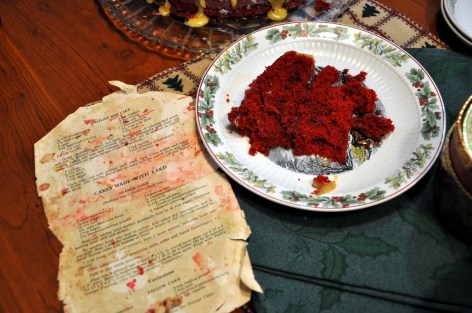
Was it about red cake?

No, not really.  Nor was it about gift exchanges or the home-cooked meal prepared by my mother’s surviving sister  — as good as both were — or about being in my sister’s lovely home, dressed so fine for the holidays  — as good as that was.

No.

No.

No.

In truth, it’s hard to say what yesterday was about.   Except that it had something to do with Mother.  And something to do with Aunt Jo, too.  And a whole heck of a lot to do with this deep down desire of mine  — and maybe others too  — of keeping their memories alive.

It was in this vein that we assembled; Mother’s sister, both daughters and ex-daughter-in-law and our chicks and their chicks and even one of Aunt’s Jo’s grand-chicks.  We convened to bake Mother’s red cake and along the way, we conversed.   Then we dined.  And drew numbers – not from a hat but a pretty piece of green depression glass — which allowed lucky number twelve to walk away with a bottle of White Shoulders cologne — the only scent I’d ever known Aunt Jo to wear.  And because I got Sis to climb up rickety stairs into a cold attic to dislodge a dozen or so dusty paperbacks, we each picked out a vintage Harlequin Romance —  to keep or do with as we will — as a visible reminder of Mom’s life.

But keeping a memory alive is a tricky business.  It doesn’t just happen —  nor does it happen, I think, by keeping up certain traditions or by following a recipe to the letter.  At least, this is what I woke up to this morning.  Because yesterday, though our red cake was a little crusty around the edges, and therefore, less than perfect — though we fell short in recreating Mom’s legend of a red cake — we walked away with something better; we walked away with not just a piece of dry cake, but a piece of Mom’s reality — something a little crusty around the edges — something a little like Mom would have baked herself — something even close to the person Mom was in real life.

Mom never baked a perfect red cake — as far as I know.  If not dry, wasn’t it  lop-sided?  And didn’t most come out of the pan only partially  — the rest following suit only after a hearty bang?  And weren’t they cracked down the middle.  Or had a side lopped off?   Or sometimes both —  in a particular dismal year of holiday baking?

Mom was not used to working with or toward perfection.  But give her something broken — something dinged up — something that needed a fresh coat of paint and a little bit of love — well that, she could work with.   And goodness knows, baking a red cake was no different —  whatever fell apart was simply put back together as best she could, with toothpicks and some of that gooey frosting she made —  the frosting that set her red cake apart from all others.  I don’t ever remember Mom fussing over her visibly flawed red cake creations.  She simply did that day’s best.  Then released them  — usually, with some off-hand benediction  —  something like, “Well, that’s all I can do to make it right.”

I miss Mom’s imperfection and her acceptance of imperfections — both in people and in life’s situations.  I miss her ability to walk away from a less than perfect cake (or life) without a backward glance or desire for do-overs; I miss her uncanny knack of knowing how best to put the pieces of life back together when things get sticky but unglued — so that all involved could move on after taking deep breaths.  Not because everyone and thing was ‘all better’, of course —  but because everyone was still together — in spite of it all.

Yes, yesterday’s red cake was more about the crusty reality of Mom than whatever our affection and memories of her in the intervening years have made of her.   And like any litmus, it revealed a substance of reality.