Rich Man Poor Man

Tags

, , , , ,

“We are not human beings having a spiritual experience.

We are spiritual beings having a human experience.”

Pierre Teilhard de Chardin (1881-1955)


These mystical words of Pierre Teilhard de Chardin, a visionary French Jesuit priest and scientist, feel true to my experience.  Yet they beg the question – to what end?  Why would a human experience be essential to our development as spiritual beings?


The answer comes out of the death  of a loved one and out of every important relationship we treasure.  If my mother’s life and death taught me anything, it’s that our human existence is about love, from beginning to end–how to grow it, how to share it and how to gracefully receive it.  Only love is eternal.  Only love is essential.  Only love survives the grave.  Didn’t the Beatles say the same thing –“love is the only thing” – in their song, “All You Need is Love?”  


Love grows out of humility, like a garden grows out of the rich dirt of humus.  Neither just happens.  Both take a whole lot of work.  In the gardening realm, especially here in Oklahoma where red clay lays just under the earth’s surface, dirt must be amended in order to create the proper environment for growth.  When preparing the soil of my new backyard garden last fall, I dug up a small dump truck of red clay and stones and replaced it with cotton burr compost and spagham peat moss, mixing both together with the remaining soil.  Digging up the red clay was back breaking work.  But, in comparison to the amending spiritual practice of humility, it was easy.


Humility requires us to empty ourselves of pride and the desire for honor and riches, which have no currency in the spiritual realm.  Like Jesus, we are called to travel the road of life lightly, without a lot of baggage, so that honor, possessions and pride do not insulate us from others and ourselves.   Cultivating a humble spirit in which to grow love takes more than a truck load of apologies, forgiveness, and putting others before our own needs.   And over the course of our human experience, we keep from strangling on humility by taking many, many deep swallows of pride.  As hard as all of this sounds, it’s actually harder in practice.  


With age, I’ve come to believe environmental influences like family & friends have less to do with who we are and who we become than the unique and personal blueprint given us on the day of our creation.  All of us have God’s eternal love buried deep within us to grow and share in a way that we alone can express it.  Our life’s work is to make visible this divine love –this image of God created and hidden within us.  We do this through our daily actions and life choices, punctuated by time-outs for reassessment of life purpose and direction. 


So what does this divine spiritual image of God look like in you?  Click here to go to The Upper Room, where you can begin to answer this question by taking a short test to learn more about your own spirituality type. 
Sure Shot Rolls

Tags

, , , ,

It’s nice to sift through the magazines and junk mail to discover that rare piece of personal correspondence.  I could tell by its shape and size it was either an invitation or a thank you note.  And when I saw my cousin’s name on the return address, I decided it had to be the former, as I couldn’t imagine what I had done to deserve a note of thanks.

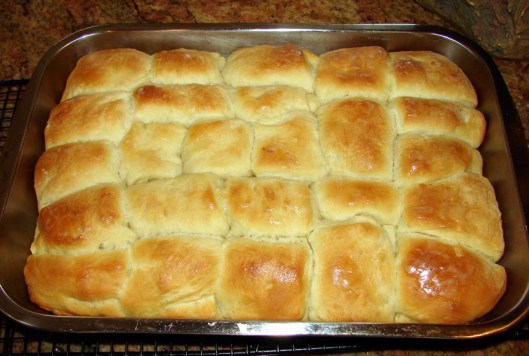
Of course I remembered as soon as I read Judy’s words of gratitude.  At my sister Christi’s urging, I had made my cousins Judy and Mike a batch of home-made rolls, using a recipe from the cookbook, Rather Sweet Bakery.  The recipe calls for over six cups of flour, so it makes a bunch of  yeast rolls.  And with just a pinch of cinnamon in them, their baking makes my kitchen smell so lovely and inviting.

At least my dogs think so.  Max and Maddie grab a spot near the oven, where they wait in anticipation until the bread comes out to the cooling racks.  Rarely are they disappointed, as this recipe makes enough rolls to share with them and enough to store in freezer bags for later.  A few hours before serving, I take them out of the freezer.  Then with a quick reheat in a moderately heated oven, they taste just like fresh baked.  And because of this, it’s a great way to share fresh baked bread with others — like Mike and Judy.

But if I could use only one bread recipe for the rest of my life, it would have to be Judy’s own mother’s recipe.  I still remember the first time I tasted these light and fluffy rolls, when Judy’s parents came to share Sunday lunch at Granny’s house.  I had never tasted anything like them and still find them special after thirty years of making them.  I’ve made these rolls so often I no longer need the written recipe.

In today’s note, Judy asked for a bread making lesson.  She wrote that learning to make bread from her mom was one of her ‘wish I would haves’ that she regrets not doing before her mom died.  I know exactly what she means, as I too have my own ‘wish I would haves’ with my own Mom. But rather than the Rocket Roll Recipe I used a couple of weeks ago, I wonder if Judy might enjoy a bread making lesson using her mom’s own recipe.

I could hunt down my old recipe card of “Patsy’s Sure Shot Rolls” that I recall is in Judy’s own hand.  And together, we could honor the memory of Patsy as we followed the recipe Patsy handed on to me through Judy’s hand.  And that I now hand on to you.

Patsy’s Sure Shot Rolls

Makes 2 dozen rolls

Preparation Time:  Total 4 hours – ½ hour preparation time &  3 ½ hours rising time

Dissolve 1 package of dry yeast in 2 Tbsp of warm water – set aside to rise for 5 minutes

Mix in a large bowl until dissolved:

1/3 cup of canola oil

1 cup of hot water

6 Tbsp of sugar

¼ tsp salt

Let water cool, then add:

1 egg, well beaten

Yeast mixture

Finally,stir in until dough forms:

3 ½ cups of All Purpose Flour (or enough to make a stiff dough)

Let rise 2 to 2 ½ hours.  Then, on a lightly floured surface, roll dough to 1/4 “ thickness.  Cut dough with kitchen sheers or an inverted glass.  Fold cut dough pieces into half and pinch together.  Turn over in a greased 9×13 cake pan and let rise about 1 hour.  Bake 20 minutes in a 350 preheated oven, or until golden brown.

Best when served immediately.

Knocking On Truth

Tags

, , , ,

“… truth outlives pain, as the soul does life.”
                       — Elizabeth Barrett Browning


As a young mother, I often listened to stories of injustice told by my children, knowing I was hearing some version of the truth.  Once they were done spilling their guts, I asked about the other side of the story, the one the other mother would hear.  “The truth lies somewhere in the middle,” I’d say, knowing my point was falling on deaf ears.    


Speaking truth is important to me.  But at best, I am clumsy in speaking it.  I get tongue-tied.  And while much better at writing than speaking truth, even here, what I birth into the world is maimed rather than whole.  I am at cross purposes right now with a beloved child—I tried to express truth that I could not–and between the speaking and the listening, we could not grasp the truth waiting to be claimed in the middle.  My child gave up in frustration, and for now, the door is closed.  I must take time before knocking again.  And meanwhile, become like a Jehovah’s Witness on the doorstep, as I patiently wait for the door to crack open.       


In still thinking about last week’s retreat, I realize Jesus understood better than I this matter of closed doors and the failure to convey difficult-to-grasp truths.  Jesus was always in the uncomfortable middle–as truth always is–while the parties on either side of Jesus changed with the situation.  Sometimes it was his disciples against the needy.  Sometimes it was the Pharisees against the needy.  And on the night of his arrest, Jesus found himself in the middle between the Jewish and Roman authorities and neither seemed as interested in truth as in preserving their way of life.   


Jesus went against the grain when he was arrested, by not inviting his disciples to follow him.  Not even the three who had witnessed his transfiguration high and Gethsemane low were invited, though two followed anyway.  Jesus surrendered, asking the soldiers to let his disciples go free.  Keeping the disciples away from the fray would not only protect them but would protect the way of truth that defined Jesus’ life.   And Jesus knew just how hard speaking truth would be as lives hung in jeopardy, as Peter discovered firsthand, when he lied three times about knowing Jesus. 


Jesus made it easy for his executioners.   Speaking a few words of truth, he gave the Jewish authorities exactly what they needed to press charges against him.  And when it came to cross-examination by the Roman governor Pilate, Jesus offered little in the way of self-defense.  At least, no truth Pilate could grasp.   


“What is truth?” Pilate asked Jesus.  Much to the Jews revulsion, Pilate ends up writing the answer to his question on a wooden sign in three languages–“Jesus of Nazareth, King of the Jews”–which was hung high on the cross above a crucified Jesus.  “What I have written, I have written,”, Pilate says in dismissal as he slams the door on ‘the Jews’ complaints.  Perhaps Pilate found truth a little easier to communicate in writing as well. 


Jesus died on the cross in the middle, spilling his blood in the gospel truth.  And three days later, the resurrected Jesus began his wait as the middle person of the Trinity.  Forever at cross purposes, Jesus stands on the doorstep.  He knocks.  He waits.  And if the door opens, truth waits to be seen, to come out of the middle, to be embraced and claimed for all time.  


And why not?  There’s no need to knock on wood if you can knock on truth.