
Spelling Bees and Such

Tags

, , , , , ,

This side of the Iowa Summer Writing Festival, writing is grand except when it’s not.

For the record, yesterday was definitely a ‘NOT” sort of day.  Which means I know I should have given it up and enjoyed my latest Richard Russo novel.  But, no.  I kept banging away at the keyboard  — like a fool in pursuit of fool’s gold —  drawing line after line of gibberish, circling back and forth, top to bottom, until,  — TA-DA — Five Golden Rings.  I mean, five digital pages.

What can I say?  I was on a mad dive to reach that illusory end of my introductory chapter —  (Version 7.0) — which meant I was acting like a hawk ready to pounce on a cat.

Setting aside for a moment whether hawks can actually pounce on cats (or whether, the pouncing, in fact, works in reverse order, as it does with smaller birds — sparrows, titmice, cardinal and mourning doves…), the word ‘cat’ is the very place I wish to pounce upon myself, because by the end of yesterday, spelling first-grade words like C-A-T felt WAY out of my reach.

Yesterday, I slapped away at that keyboard for eight horrible hours.  Okay, maybe it was ten.  The point is that I knew I was typing crap, I knew that very few lines were keepers, but I kept working anyway.  Why, if my husband hadn’t sounded the gong to let me know that women’s gymnastics was on the family room telly, I might have written another two hours.  Or more.
There are two things about my watching women’s gymnastics last night that I found helpful to my writing life.  One was just sitting like the proverbial couch potato with my mouth wide open. Yes, like the rest of the Summer Olympic television audience, I was under the spell of those young women from Romania and Russia and China and Great Britain and the U.S.A.

I mean, did you happen to catch those circles that they wrote with their bodies?  In the air while landing on a four-inch wooden apparatus  — making it all seem like child’s play?  Except, of course, for those who were having a bad writing day.  Like me. These I saw missing the plank and landing on the floor. Kerplunk.

Medal-winning performances are grand, of course, but I found myself admiring the fallen gymnasts more.  Especially as I watched them pick up their disappointed selves and stiffen their resolve and climb up and finish their circles on top of that straight thin line, even though they knew there would be no medals for them, at the end of their fabulous circling dismounts.  Except for the one who landed on her buns.

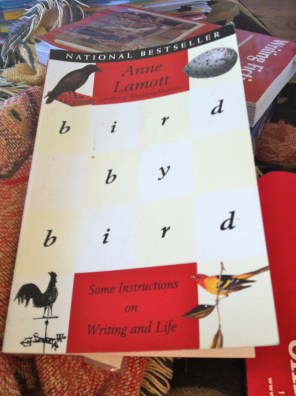
The second thing about my television break that i found helpful came from grabbing one of my favorite inspirational writing books by Ann Lamott, which I began to read again, between gymnastic routines.  It’s called bird by bird, and if you’ve never had the pleasure, I heartily recommend it for your writing life.  The book is hilarious.  HILARIOUS.  Especially the part where Lamott waxes poetic over the need for shitty first drafts.  I went to bed last night feeling a little more hopeful than I otherwise would have, thanks to that creative break, which felt sort of like a coaching session.

And this morning?  Well, today I woke into a great writing life.  Not only could I spell C-A-T but sometimes, I was also able to spell C-A-T-I-P-I-L-L-A-R.  And once, though it was a long way off, I could almost catch a glimpse of what those digital scribbles on the page might one day become.  After its chrysalis break-through.

I also decided, this morning, that I would no longer write to o’dark hundred any day of the week.  And today, I slipped, and worked to 3:14.  But from here on out, it’s a 9 a.m  to 3 p.m writing schedule for me — and I’ll write within this carved block of time, whether it means six hours of writing or something much less.

No matter what.

No matter what birds or bees or cats or caterpillars or hawks might be circling around my mind or page that I feel the need to chase.  And at the other end of the balance beam, no matter what wicked witches from Kansas (or neighboring corn-growing states like Iowa?), might be writing nasty messages —  in circles, with their broomsticks in the sky — beginning with the word,  S-U-R-R-E-N-D-E-R.

Surrender?  Never.  No matter what.  Unless it’s another day like yesterday.

Pencils & Prose & Who Knows

Tags

, ,

This past week in Iowa, at points, has felt as hot as Hades.  Which may explain why, this second time around, the Iowa Summer Writing Festival has reminded me a little of those charismatic tent revivals of my youth.

Not because it was the Festival’s business or even their intent to save souls or inspire folks to immerse themselves in the baptismal waters of the word.  Nor was it  — where these two acts, in previous meetings had not accomplished the ‘write’ trick — to pray folks out of their hard, unforgiving pews to walk down to the altar for a very public re-dedication to the word.

What this means, in part, is that I never once encountered anything akin to the eternal drone of words, heard from upon high, more effective than Sominex,  — that when mixed with occasional outbursts of fervent hallelujahs — worked upon me like a buzzing alarm clock.  Nor did I have need to entertain myself in meetings by passing down folded-up notes to friends —  or occupying myself with rolled-up paper to swat flies and mosquitoes lighting on my sweaty skin — though it’s true our classroom’s air-conditioning was broken during the two hottest days of the week.

All this, of course, is a way of saying that the week in Iowa has been beyond the wonder of dreams.  That I found better uses for paper and lived like a monk on retreat from the world, shying away from all forms of amusement except what rose out of the working of words. And that while no one set out to save me from my lazy and distracted self, maybe it happened anyway.   Because  — and God help me to articulate it — this morning I feel much like I did when I was seven and freshly “saved” — thanks to those lovely church ladies of summer vacation bible school — after I walked down the altar and walked away a little confused.  I was at a loss for words when folks, then, asked me about it afterward.   Then, I didn’t know what to say because I didn’t quite know what had happened, if anything — where now, I don’t know what to say because I don’t know what has happened, if anything.

So unlike Moses, while I leave a sacred place, I do so without trekking down any mountaintops with stone table of commandments in my hand.  Instead, I tip-toe away quiet and with a fair share of humility.  For just as I did the first time around, when I attended two years ago, I leave knowing what I don’t know.

Except that weather forecasters are predicting another round of scorching heat for today.

Midnight’s Children: The Final Jar of Time

Tags

, , , , , , ,

Funny, isn’t it?  That twenty days after first tasting the final words of Midnight’s Children, I’m still pondering those pickle jars.

So why pickle jars?  And not the exotic people, places and things introduced into my mind, by the magical writing of the now-you-see-it-now-you-don’t author, Salman Rushdie? (Can anyone use that “writery” trick of foreshadowing as effective as he?)

How can it be that it’s the image of thirty-one pickle jars trumping all else, in the end?  Especially that one.  You know.  On the end.  Empty and waiting.

Twenty-six pickle-jars stand gravely on a shelf; twenty-six special blends, each with its identifying label, neatly inscribed with familiar phrases:  “Movements Performed by Pepperpots,” for instance, or “Alpha and Omega,” or “Commander Sabarmati’s Baton.”  Twenty-six rattle eloquently when local trains go yellow and browning past; on my desk, five empty jars tinkle urgently, reminding me of my uncompleted task. But now I cannot linger over empty pickle-jars; the night is for words, and green chutney must wait its turn.”  —  p. 443

Pickle jars represent chapters; thirty full jars equate to thirty full chapters of the novel.  Thirty full chapters of the narrator’s Saleem Sinai’s life.  So full —  not of preserved cucumbers — but of a cucumber-nosed narrator’s stories, dreams and memories truth.  Artfully told.  Artfully preserved.  Artfully titled, with chapter headings that hide as much as they reveal; “Movements Performed by Pepperpots,” for example.  Hmmm.  What might that concoction smell and taste like?

I wouldn’t have written these words twenty days ago. Because the words and ending felt flat first-time around.  The final bite of words left a bad taste in my mouth.  Like onions that linger to overstay their welcome.

I expected something spicy.  Something like all that had come before.  After all, I had followed the narrator through India, Pakistan and Bangladesh —  through the ups and downs of his dramatic “India-talkie” life.  And like a child-soldier, I longed for a little more “Ka-pow’ for the finale.  Know what I mean?

I should have known better.  By now, I should have known Rushdie better.  Because, as with Books One and Two, it’s the second reading where appreciation for Rushdie’s novel grows, where chapter contents begin to meld into flavors both fabulous and subtle on the tongue and mind.  Cucumbers, after all, are not pickles overnight.  And neither are Rushdie’s pickle jars of stories.  They require time and space to appreciate fully.

“One day, perhaps, the world may taste the pickles of history.  They may be too strong for some palates, their smell may be overpowering, tears may rise to eyes;  I hope nevertheless that it will be possible to say of them that they possess the authentic taste of truth… that they are, despite everything, acts of love.” p. 531

Truth.  Again it’s truth.  Truth floating up and swirling all around.  No longer truth in general, but truth in particular.  Truth as it’s embodied in a particular person.  Truth as it’s embodied in the narrator, Saleem.   And truth as it’s lived out (or not) by a country’s leaders. Military might as well as political power.  India.  Pakistan.  Eeny.  Meeny.  Miny.  Moe.    But rather than summarize, I prefer to get out-of-the-way, and let the Master Magician pull those ‘true-self’ “Rusdie-isms” out of his own top hat.

“Don’t you remember really?  Nothing? Allah, you don’t feel bad.  Somewhere you’ve maybe got mother father sister,” but the buddha interrupted him gently:  “Don’t try and fill my head with all that history.  I am who I am, that’s all there is.” [emphasis added] p. 403

“In the aftermath of the Sundarbans, my old self was waiting to reclaim me.  I should have known:  no escape from past acquaintance.  What you were is forever who you are.”  [emphasis added]  p. 423

“I no longer want to be anything except what who I am.  Who what am I?  My answer:  I am the sum total of everything that went before me, of all I have been seen done, of everything done-to-me.  I am everyone everything whose being-in-the-world affected was affected by mine.  I am anything that happens after I’ve gone which would not have happened if I had not come.  Nor am I particularly exceptional in this matter; each “I,” everyone of the now-six-hundred-million-plus of us, contains a similar multitude.  I repeat for the last time”  to understand me, you’ll have to swallow a world.[emphasis added] p. 440-41

Simply beautiful.  Don’t you think? But as I said at the beginning, it’s the ending jar that gets me.  The jar that remains empty, since it represents the narrator’s future. And not just Saleem’s future, but my future, too.  And your future. And all of our futures.  Eeny.  Meeny.  Miny.  Moe.

Last days.  Last words.  Last breaths.  And then, eternity.  Yes, in the end, knowing ourselves — our true selves — requires accepting our own mortality.  Our own emptiness.  Our now-you-see-us-and-now-you-don’t selves. Which reminds me of Rushdie’s fabulous take on the after-life where we get a taste of invisibility through Parvarti’s magic tricks…. p. 438-39

And so much else, that I’ve no time to go there….

But later.  Maybe, then.  Maybe, then, we’ll have more time.  For as the great Rushdie, himself, once wrote,

“To pickle is to give immortality, after all…”  p. 531

————

Note 1:  For other book reviews, pop over to Arti’s place and follow the links.

Note 2: All page references are based on the 2006 Random House Trade Paperback Edition.