
Tags
Books, Lent, The Moviegoer, True Self, Walker Percy, Writing
 Had it not been for the controversy stirred up by that small panel of judges who decided the winner of the 1962 National Book Award for fiction, I would have devoted most of my November reading time to another novel. Those now classics that were heavily favored to win — J.D. Salinger’s Franny & Zooey and Joseph Heller’s Catch-22 — were bested by an almost unknown novelist, Walker Percy, who received the award for his slim debut novel, The Moviegoer.
I like this story behind the story. I like it very much, in fact, since surprise keeps us on our toes and helps us not sleepwalk through life. The latter, in fact, is one of the central themes of the book. But in spite of the wake-up call offered between its covers, reading Walker Percy’s story sometimes left me limp with sadness. I don’t know why; but the fault may lie with the lurking villains of despair and malaise that cast long shadows upon the story. So with that, I’ll confess that it helps to read the novel on sunny days. And too, that it can’t hurt to linger on that epigraph, from Søren Kierkegaard, rather than rush past it as I did the first time:
“….the specific character of despair is precisely this: it is unaware of being despair.”
The back cover summarizes the story as a “portrait of a boyish New Orleans stockbroker wavering between ennui and the longing for redemption… on the eve of his thirtieth birthday.” Inside the covers lies Percy’s beautiful prose and the deep thoughts he serves up like some trifle. There are too many to share. So I’ll move on by saying how I like that the story was a time capsule of the early sixties South. It was interesting to contrast life then and now, and ponder places where we’ve changed and where we have not. But it was meeting the unforgettable protagonist, Jack “Binx” Bollings, who narrates the tale in a colorful first-person voice, that hooked me from the first paragraph:
“This morning I got a note from my aunt asking me to come for lunch. I know what this means. Since I go there every Sunday for dinner and today is Wednesday, it can mean only one thing: she wants to have one of her serious talks. It will be extremely grave, either a piece of bad news about her stepdaughter Kate or else a serious talk about me, about the future and what I ought to do. It is enough to scare the wits out of anyone, yet I confess I do not find the prospect altogether unpleasant.”
I’ve read that Percy admired Tolstoy. He mentions War and Peace in the text. And like Tolstoy, Percy possesses the courage and willingness to touch upon weighty matters affecting the human spirit. Over and over, I learned of some loved one Jack had lost. His brother on page one or two. His father, a few more pages in. Others, later on. But physical death aside, Percy touches upon the illusory curing power of money and sex and drugs and religion and even war. And since this story is set in the sixties South, there was plenty of discrimination to bump up against: Women and racial and not just between blacks and whites. Sometimes, Binx stepped on my toes with his truth. In one passage, it happened to my particular truth du jour:
“Once I thought of going into law or medicine or even pure science. I even dreamed of doing something great. But there is much to be said for giving up such grand ambitions and living the most ordinary life imaginable, a life without the old longings; selling stocks and bonds and mutual funds; quitting work at five o’clock like everyone else…”
I’ve been thinking a lot on how sweet life would be if I were not trying to realize that dream of fictionalizing my father’s story, who coincidentally, also happened to be a moviegoer by the name of Jack. It would be easy to coast through days if my biggest challenge turned on the decision of what to fix for dinner. How easy and lovely to while away hours in the garden or painting the exterior of my house or my dining room for the fifth time. What joy to simply feast upon the artistic endeavors of others …while enjoying the taste of a few bonbons on my tongue.
Too bad the The Moviegoer is not a bonbon eating sort of book. Instead, it’s the sort some keep company with every Lent. Its existential subject is made for mulling over. And its New Orleans setting into time makes it perfect for Lent, since the story takes place the week leading up to Mardi Gras. But writing this hits me hard, since Lent is not about feasting and bonbons at all — and more about fasting in the wilderness and facing up to personal demons — for forty days and nights — which biblically speaking, translates to a helluva lot of time.
So do forgive me… if I leave those ends a little loose, to keep the noose from growing tight, in order to travel down a different line of thought. Having spent a lot of time with this cagey old novel, I know that good ‘ole Binx would agree that it’s easier to be a spectator than a doer. It’s much more enjoyable to read (or see) a good story than to try and write one. And if my year boils down to any thoughts on writing, it’s that it takes a lot of desire and hard work to write fiction. And that I’ve learned I lack what it takes in both departments. Which is not all bad, since this year spent working on my father’s story has shattered whatever false illusions I once had about story-making.
I part ways with The Moviegoer with a lot to wonder over. For one, if I can’t imagine writing at a publishable quality, how difficult was it for the newly published author Walker Percy to think his writing ‘good enough’ for some prestigious award. His own publisher didn’t support his nomination; it came by unconventional channels, which a surprised Percy didn’t learn of until a few days after the ceremony.
I also wonder over those other ten finalists who lost that year. How did they feel after coming so close — after all that hard work — with all those expectations of taking the prize?
I’d like to think that maybe a few of them pick up The Moviegoer to see what Percy had to say. It’s not a bad notion to think upon… for some sunny day…or over forty days of some upcoming Lent. If the idea grows to reality in my life, it would make my third time to read it. I don’t mind saying that there’s something holy and complete about that number three that I’ve always found difficult to resist. Much harder than a mere box of bonbons.
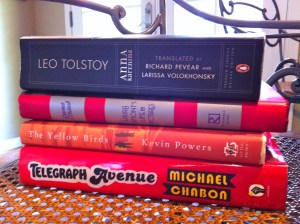 It was my first time to read Tolstoy’s Anna Karenina, but not
 I can’t remember what we were talking about last July in class, when the thread of discussion turned to Tolstoy’s, Anna Karenina.
 an everyday life