
• About
  • Recipe Index
  • Daddy Oh

an everyday life

an everyday life

Tag Archives: Books

Midnight’s Children: Half-Time Report

30 Monday Apr 2012

Posted by Janell in Good Reads

≈ 10 Comments

Tags

Books, Listening, Midnight's Children, Salman Rushdie

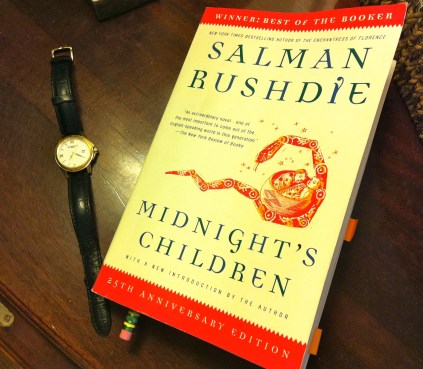
Half the words without half the story.  That’s my quick, half-time recap of Salman Rushdie’s hard-to-put-down novel, Midnight’s Children.

How tempting to leave it at just that.  I can’t say why, but I’m not ready to talk of what I’ve read quite yet.   But ready or not, it’s time to share notes with read-along partners — and any other who desires to listen in — though to react at all, feels plain premature at this point of the tale.

In this month’s reading, the spotlight shifts from the narrator’s holey grandfather to the young narrator himself.  It’s a story about growing up, endearing as it is universal.  I like this narrator.  No, I love this narrator.  Snot-nosed and ugly and misunderstood he may be, but how can one not admire his youthful idealism and brutally honest self-assessments?

Rushdie’s story just grows and grows, making it hard to point a finger at any thing in particular.   It grows like the young babe Saleem — and it grows like the population of India, too — though, thank God, it does not grow uncontrollably.   But at this point of the story, I wish I possessed greater understanding of how the young narrator, Saleem Sinai, is a mirror of India’s own young life.  While I sense that child and country are inextricably linked, for better and worse, I don’t yet understand HOW this is.  Yes, both experience growing pains from internal turmoil and blood-letting.  But surely there is more to their common ground than the story has currently revealed?

I’ve glimpsed three great religions and God-knows-how-many-languages and voices influencing both India and Saleem.  I see both growing up under the watchful eyes of an expectant world, waiting for a sort of payback on investments and loans.  And unlike the country of his birth, I’ve watched a young narrator become absolutely consumed with need to understand his larger purpose in the world. So much so, that Saleem is in constant need of a hidey hole to escape the pressures of his world.

Hiding that begins in the physical world — from a washing-chest in his mother’s bathroom to a clock-tower next to his parent’s home — becomes mental, growing out of Saleem’s interior world and a couple of physical blows to the head.  The last, a childhood mishap, finished the work of his father’s hand and “wild anger,” which left Saleem’s left ear permanently damaged.

So what words could beget such parental violence?  I’ll only share that Saleem was premature in his conclusions.  That Saleem was wrong.  That his parents more wrong.  And that maybe there’s plenty of wrong to go around whenever any of us fail to listen to others as fully as we can. Or ought.

But lack of listening isn’t Saleem’s problem.  Not at all.  Because, much like a radio, Saleem is gifted with a fantastic ability to tune his mind into other minds, to eavesdrop on real-time thinking of friends, parents and politicians.  What begins as simple mind-reading soon mushrooms into a type of telepathic communication center — where Saleem’s mind becomes much like an internet server, allowing Midnight’s Children — those uniquely gifted Indian children born in the first hour of Indian Independence — to communicate with one another.  There he meets scary Shiva — the true son of Saleem’s parents born at the same time as Saleem and India — who is dark to Saleem’s light and pessimist to Saleem’s idealism, hinting of conflicts to come.  What grows from this conflict is for the second half of the book to reveal.

But what, I wonder, will grow from all I failed to mention? Evie Burns, for example?  The Brass Monkey of a sister?  And all those with bald heads that keep popping up from time to time, on the pages of this book?   Who can say, at this point, whether any and what and who are the red herrings of this story? Who knows but what may ultimately become important in this fabulous tale?

Especially, with a narrator who laments, in the final paragraphs of this month’s section of reading, this bit of wisdom to fly off the page…

“Most of what matters in your life takes place in your absence.”

With words like these, I can only conclude I don’t know the half of it.
Time for Midnight’s Children

31 Saturday Mar 2012

Posted by Janell in Good Reads, Life at Home

≈ 11 Comments

Tags

Blogging, Books, Midnight's Children, Salman Rushdie, Writing

I’m not sure why I said yes.  I’m no good at book clubs and reading groups.   But in spite of past failings, and because I fell in love at first sight with the novel’s opening paragraphs, I signed on to read Salman Rushdie’s award-winning Midnight’s Children.

Rushdie birthed this masterpiece while I was in the midst of mastering the pieces of my busy young life  — marriage, career and motherhood without apple pie but plenty of midnight feedings to compensate.

Older, if not wiser, I’m still busy.  It’s the way I keep time.  But not too overextended for this travel piece —  this story in a story that I believe, once I’ve arrived to the final word and period, may point to some greater truth that lives just off the page.

Why do I think this?  Well, because this story moves. Though not always in chronological order.  Like a pendulum, the story grants peeks into the future, speaking of events and characters without proper introductions — then swings back to make sure we’re still hanging on to the story line.  In a fictional world where time is elastic — stretching forward, snapping back, keeping readers at attention — it’s good that Rushdie never loses control.

We are safe, following the trail of words left by expert hands, even while “traveling” such strange lines across India, even as we careen through the countdown of time to reach the end of British colonial rule.  Strange, as in, where are these sentences leading me?  And where will they take the three generations of family the author introduces in Book One, whose lives intersect with the wilds of three great world religions?

Hinduism, Islam and Christianity are all present and accounted for — while the story’s patriarchal grandfather, poor soul, loses his faith in God before we’re barely out of the gate.  It happens — on page two of the story — in such a humiliating, unforgettable way: Nose first, Aadam Aziz dives to prayer mat and, rather than encountering God, crashes into the earth.  Three drops of blood fall.  A hole in his soul opens up.  And his faith in God leaks out so fast he becomes “caught in a strange middle ground, trapped between belief and disbelief…”  Readers are left with a holey hero, who lives a young life into an old one, stuffing his hole to the brim with marriage and career and children.

Hmmm.

I’m thankful to the wise organizers of this reading experience who built in plenty of time for spacious reading. The schedule has not only granted breathing room for life but allowed me to fly back to the beginning to re-read Book One with “traveled eyes.”  Once was simply not enough for me, since I missed too much, even traveling slow.  I was getting the gist of the story but leaving too many fine details and scenery behind.

I don’t want to miss anything along the way, if I can help it.  Every word, every image, every potential connection that bridges one idea to another feels important.  Of course, I am missing details.  How can I not?  There is just too much to take in.  And the author knows it.  He has written a novel made to read over and over again; he implies as much when he writes, toward the end of Book One,

“To understand just one life, you have to swallow the world.  I told you that.”

Since I’m just a “tourist” traveling in a foreign land and time, I cannot hope to swallow Rushdie’s world.  But like any tourist, I hope to carry away sweet memories of my visit.   And, since I do not armchair-travel alone, I look forward to enlarging my perspective by reading other reactions to Rushdie’s story at today’s first of four meeting stops.

Maybe others will mention why they said ‘yes’.

Link to other reviews...

Alarm Clocks and Prizes

08 Wednesday Feb 2012

Posted by Janell in Life at Home, Writing

≈ 2 Comments

Tags

Ancestor Research, Blog Giveaways, Books, French Antques, Greek Immigration, Jean Jacques Barthelemy, Prizes, Story Telling, Strawberry Alarm Clock, Tongue in Cheek, Voyage du jeune Anarcharsis en Grece, Wriitng

The cover of the old paperback came worn.

More than a slight musty, it was lovely anyway, a dusty pink on both sides, except where edges had frayed and the pink had curled back into the crinkled parchment beneath.  In these threadbare spots of its reduced state, it wore the color of old undergarments, many washings faded.

The cover was bare of words, offering no hint of its subject matter or author. Yet, in spite of great age, the spine and binding held tight to its pages.  Each sheet felt heavy though only few showed signs of heavy pressing, and on these, French words rose up like goose-flesh on thick skin.

Opening the book to the title page, my eyes ran down lines of words written in an unfamiliar tongue, before tripping over the last two — “Voyage du jeune Anarcharsis en Grece,”  “En Grece?”  “In Greece,” it read.  This old paperback, published in 1789, —  which I’ve since come to know written by Jean Jacques Barthelemy (1716–95),  — describe on Wikipedia as “a highly esteemed classical scholar and Jesuit” — had traveled many miles and years to find a new home with me.

I won the book through a blog giveaway entered January 12th.  It had been a long spell between prizes.  Ignoring two winning hands at a San Juan Blackjack table in the mid-eighties, I was thirteen last time I’d won anything.  But, oh what a win that was.  The prize was a true sign of the times in which I lived, since I received two free tickets to go see and hear the Strawberry Alarm Clock perform in Oklahoma City.

Like the paperback, I won these by random draw; a DJ of a local radio station picked my entry form out of a small box parked on the customer service counter of the grocery store where Mother shopped.  I’m guessing there were few entries that day.  Most Buchanan patrons were not hip — like my parents, they tended to gravitate toward a different period of music, where the meaning of lyrics were easily understood and where words were sung rather than screamed.  Buchanan’s patrons would not have recognized the Strawberry Alarm Clock as the name of a sixties psychedelic rock n’ roll band.  Nor would they have recognized the band’s music as music.  In other words, I had excellent odds of winning that day.  My name may have been the only one in the box.

Yet, I don’t think I had any thought beyond winning.  In my young mind, I never imagined I would go or wouldn’t go.  But if lucky enough to get my hand on those tickets, surely I dreamed of going.  And when I did win, it seemed a clear sign that somehow — in spite of being too young, in spite of having a pair of Southern Baptist parents wary of all the dangers of drugs and booze and the make-love-not-war mindset of the sixties — that somehow, I would go.  Somehow, I would hear this up and coming band on the music scene sing their one hit single live.

But no, somehow never happened.  So somewhere in this house, buried amongst all the scraps and photo treasures of my life, are two unused tickets to that 1968 concert.  And the shame of it?  The shame behind that somehow is this:  that I never ever raised the question.  Oh, to be sure I would have dropped huge hints hard to ignore — for anyone but a parent wishing to dodge sticky situations — but I never spoke the question to life.  There was no “Can I go?”  I never made my parents tell me ‘no.’   Somehow, my dream died a natural death as we all do —  it just ran out of time, that’s all.

Last night, remembering those unused concert tickets, I went to the living room —  where my paperback had laid for the last week — and claimed my newest prize.  And carrying it to the computer, I began to wonder about its origins and how it came to live with me and whether this antique paperback about Greece might symbolize another ticking alarm clock, trying to wake me up from a dream.

I thought about my Greek grandfather and his stories and the stories of his children that my aunt spent hours sharing with me in the months following Daddy’s death.  And I remembered before last year’s move, how I’d hoped to begin writing the stories down, so that Aunt Carol would be around to help edit away inaccuracies and embellish the story with rich details that only she could.

And I thought of everything that had come to pass for this book to arrive at my door last week — how on January 12th, I was inspired to leave a rare comment on a blog that I’ve tuned into everyday for a year for the pleasure of easy ‘listening.’  I thought of how the blog author that day was inspired to write a post, titled, “Yes You’ve Got a Story to Tell – Giveaway.”  And how before she even wrote that post, how she’d been inspired to buy my old paperback at the Brocante fair she frequents most Sundays.  And how her purchase that day had depended upon the antique dealer’s recent acquisition of an estate.  And then I thought of that long string of book owners — over 200 years of ownership deep — who had decided to keep rather than toss the book aside.  And finally I thought back to before 1789, to when the author decided to write this story, about a young man’s journey to Greece, and how he chose to tell the story in the form of a travel journal.

Somehow, all these thoughts siphon down to one last drop of thought — how one hundred years ago last May, my Greek grandfather arrived in New York as a young man with little more than a dream in his pocket.  And though he never bothered with travel journals, he left plenty of footprints — plenty of stories, that for the last year, have been asleep in a storage box in my closet.  Strangely enough, one story Aunt Carol told had to do with stories Daddy had written down in red ink about his life on the road, traveling with my Greek grandfather.  That story ended sometime around 1944, when Daddy was a young man, when he decided to toss it all away into a Kansas City garbage can

I’m thinking it’s time to wake some of these slumbering stories up — and time to push the snooze alarm off so that I can wake up from my dream — how maybe its time to grow thick skin — and stretch the boundaries of everyday life to encompass a larger map.

Can I go?  Only the prize of time and a few worn down alarms clocks can know the tale.

← Older posts
Newer posts →

“Do any human beings ever realize life while they live it? — every, every minute?”

-- Thornton Wilder, "Our Town"

Enter your email address to receive notifications of new posts.


prev|rnd|list|next
© Janell A West and An Everyday Life, January 2009 to Current Date. Unauthorized use and/or duplication of this material without express and written permission from this blog’s author and/or owner is strictly prohibited. Excerpts and links may be used, provided that full and clear credit is given.

Recent Posts

  • Queen of Salads
  • Sweater Weather
  • Summer Lull Salads
  • That Roman Feast
  • Remodel Redux
  • Déjà vu, Déjà Voodoo
  • One Good Egg

Artful Living

  • Fred Gonsowski Garden Home
  • Kylie M Interiors
  • Laurel Bern Interiors
  • Lee Abbamonte
  • Mid-Century Modern Remodel
  • Ripple Effects
  • The Creativity Exchange
  • The Task at Hand
  • Tongue in Cheek
  • Zen & the Art of Tightrope Walking

Family ~ Now & Then

  • Chronicling America
  • Family
  • Kyle West
  • Pieces of Reese's Life
  • Vermont Digital Newspaper Project

Food for Life!

  • Elizabeth Minchilli in Rome
  • Manger
  • Once Upon a Chef
  • The Everyday French Chef

Literary Spaces

  • A Striped Armchair
  • Dolce Bellezza
  • Lit Salad
  • Living with Literature
  • Marks in the Margin
  • So Many Books
  • The Millions

the Garden, the Garden

  • An Obsessive Neurotic Gardener
  • Potager
  • Red Dirt Ramblings

Archives

Categories

  • Far Away Places
  • Good Reads
  • Home Restoration
  • In the Garden
  • In the Kitchen
  • Life at Home
  • Mesta Park
  • Prayer
  • Soul Care
  • The Great Outdoors
  • Writing

Meta

  • Create account
  • Log in
  • Entries feed
  • Comments feed
  • WordPress.com

Blog at WordPress.com.

Privacy & Cookies: This site uses cookies. By continuing to use this website, you agree to their use.
To find out more, including how to control cookies, see here: Cookie Policy
  • Subscribe Subscribed
    • an everyday life
    • Join 89 other subscribers
    • Already have a WordPress.com account? Log in now.
    • an everyday life
    • Subscribe Subscribed
    • Sign up
    • Log in
    • Report this content
    • View site in Reader
    • Manage subscriptions
    • Collapse this bar
 

Loading Comments...